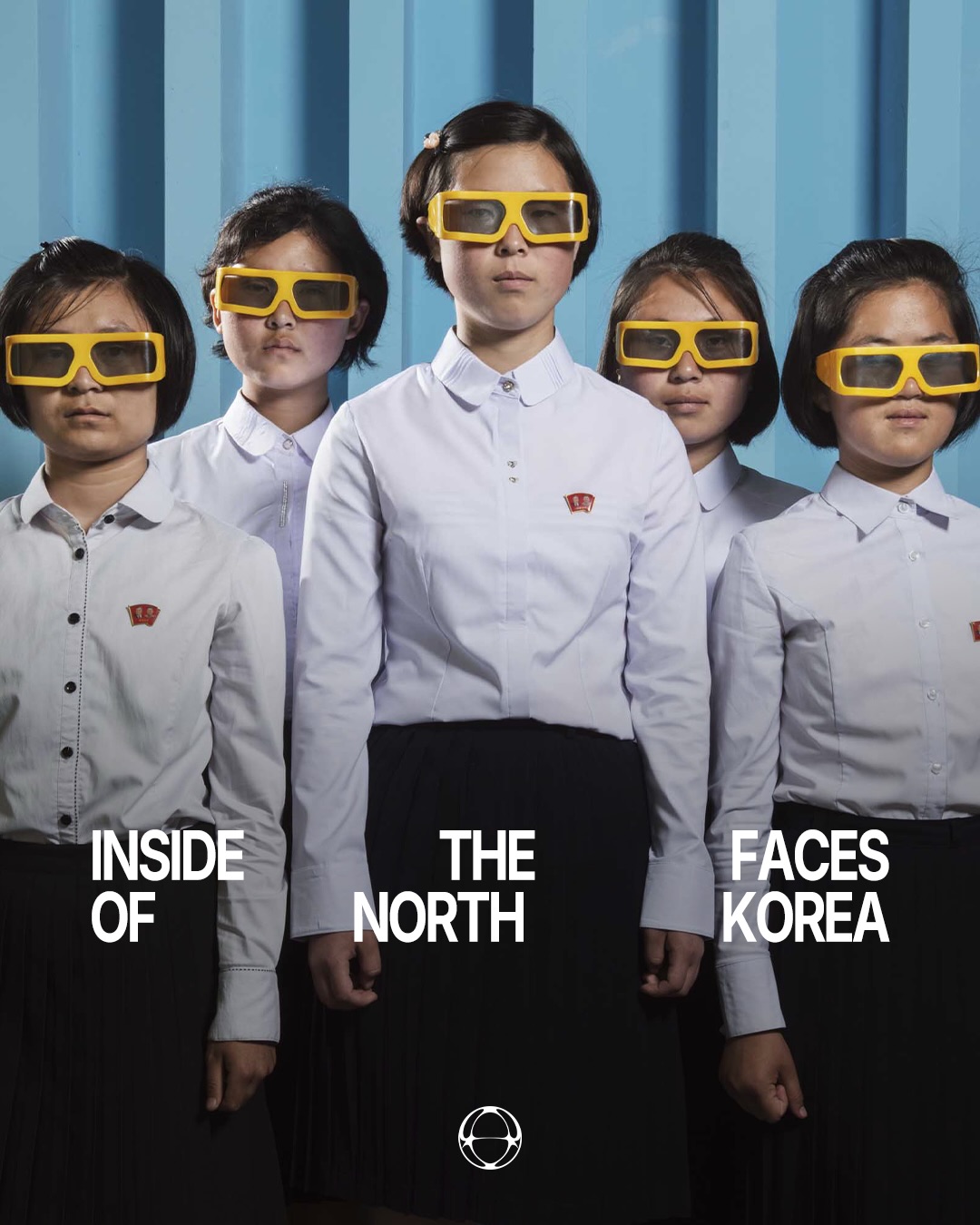
Five women wearing yellow 3D glasses, uniformed in white shirts and black skirts, their faces repeating and aligning into a single mass—this is the visual articulation of individuality fading into the collective. The cold blue tones reminiscent of a backroom and vacant expressions evoke an unsettling ambiguity, hovering somewhere between fiction and reality. The unflinching gaze confronts the viewer, blurring the line between 'real' and 'staged.'
Gladieu's work transcends mere documentation. He poses a weighty question: how does society erase the individual through manufactured faces and controlled imagery? The aligned bodies, repeated patterns, and expressionless gazes function as the visual grammar of collectivist aesthetics while simultaneously exposing the tension beneath.
PAP Magazine revisits Stephan Gladieu's North Korea series to examine how photography can pose political and social questions. His work constructs a powerful visual narrative at the intersection of fashion, photography, and cultural critique, challenging viewers to question what they see—and what lies beyond the frame.


FAQ
What does Stephan Gladieu's North Korea series explore?
Stephan Gladieu's North Korea series visualizes how individuals are erased within collectives. Through repeated faces, uniform clothing, and vacant expressions, he captures individuality's erasure in controlled societies, posing visual questions that blur fiction and reality.
What kind of photographer is Stephan Gladieu?
Stephan Gladieu is a French documentary photographer working on identity, collectivism, and social control. Rather than explaining subjects, he confronts them, known for visually capturing political and cultural tensions.
Why did PAP Magazine feature Stephan Gladieu's work?
PAP Magazine highlighted Gladieu's work to illuminate how photography intersects with fashion and cultural criticism to pose political and social questions. His visual narratives explore individual erasure within controlled imagery, offering critical perspective on contemporary visual culture.