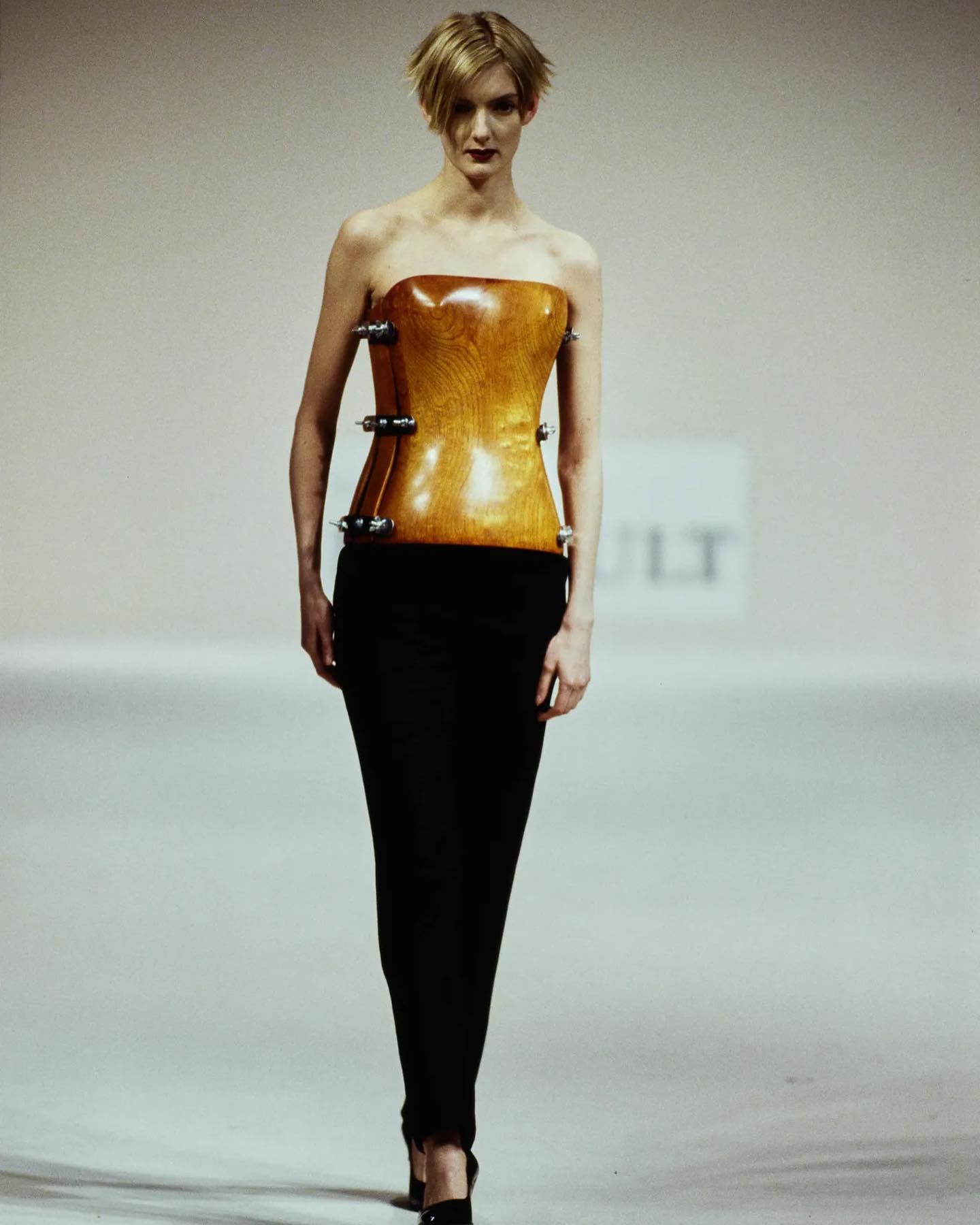
Beyond being a mere fashion item, this piece serves as a metaphor for the social landscape of the 1990s. It visualizes the invisible constraints on individuals within a society growing increasingly cold amid rapid technological advancement. By reinterpreting the corset—a garment historically used to suppress women's bodies—Chalayan articulates the isolation and restrictions faced by individuals in modern society through the cold, hard material of wood.
Yet the warm, golden hue of the wood creates an intriguing contrast. PAP Magazine interprets this as symbolizing the warmth that remains within the human spirit, even in a cold society. Combined with a black long skirt, this corset embodies the essence of 90s minimalism while simultaneously capturing the contradictory emotions of that era—coldness and warmth, oppression and liberation, coexisting in tension.
Through this collection, Hussein Chalayan proved that fashion is not merely about making clothes, but about reading the times and posing questions. Even three decades later, this wooden corset continues to ask us: In a world dominated by technology and structure, does the warmth within us still survive?
FAQ
When was Hussein Chalayan's wooden corset presented?
Hussein Chalayan's wooden corset was presented in his Fall 1995 collection. This work is a structural corset made of wooden pieces connected by metal clips, symbolically expressing 1990s societal coldness and individual suppression amid technological advancement as a representative conceptual fashion piece.
What is the design meaning of the wooden corset?
The wooden corset embodies the invisible framework constraining individuals in a society growing cold alongside rapid 1990s technological advancement. It reinterprets the corset that traditionally suppressed women's bodies to visualize modern isolation and constraints, while the warm wood tones symbolize the human warmth remaining within.
What kind of designer is Hussein Chalayan?
Hussein Chalayan is an avant-garde fashion designer famous for conceptual and experimental approaches. He treats fashion not as mere clothing but as an artistic medium that reads the times and poses social questions, establishing a singular position through sculptural, philosophical works like the 1995 wooden corset.